Resource handler model
2 minute read
Every resource handler is an instance of resourcehandlers.models.ResourceHandler. Each supported technology subclasses it: a vCenter connection is a VsphereResourceHandler and an AWS connection is an AWSHandler. The base model uses HasSubModelsMixin, meaning that a query against ResourceHandler returns base instances. Call cast() on one to get the subclass, with the fields and methods specific to that technology.
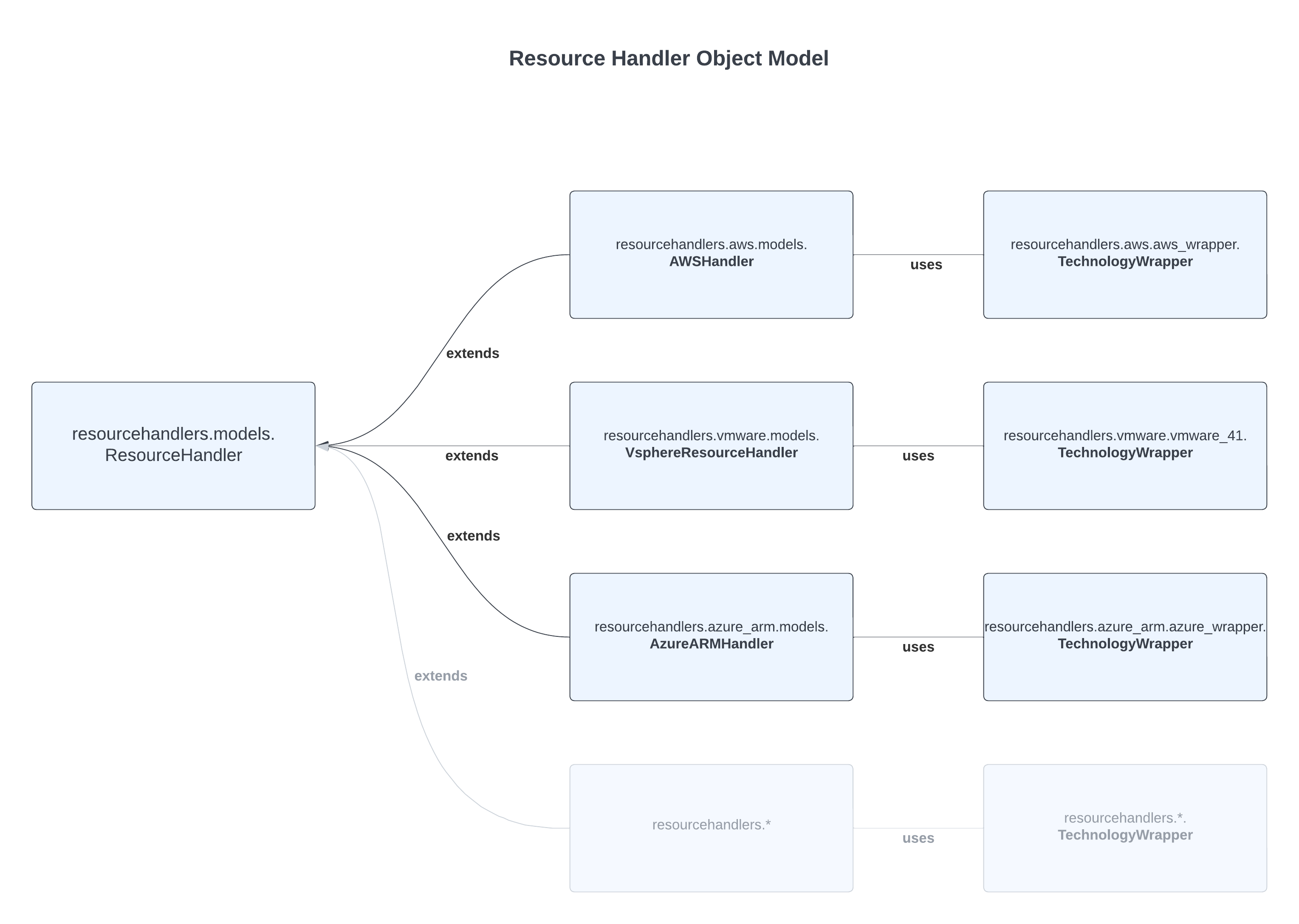 (opens full-size image in a new tab)
How a handler reaches the provider API
Each resource handler is paired with a wrapper class, and get_api_wrapper() returns that wrapper, already connected, so a plugin never has to read credentials. Wrappers share a common set of operations, including validate_connection(), create_vm(), power_vm(), and get_all_templates(). Check the wrapper for the technology you are working with.
Capability flags
Handler classes declare what their technology can do as class attributes. Read the flag rather than testing for a specific technology, so your code keeps working when another handler gains the same capability. For example:
| Flag | What it reports |
|---|---|
can_support_console |
The technology can open a remote console session to one of its servers. |
can_sync_vms |
Existing VMs can be discovered and synced into CMP. |
can_add_disks_at_prov, can_add_disks_after_prov, can_add_nics_after_prov |
Whether disks can be added during provisioning, and whether disks or network cards can be added to a server afterward. |
can_resources_be_changed |
CPU and memory can be changed on an existing server. |
can_import_networks, can_import_templates |
Networks and images or templates can be pulled from the provider. Setting can_import_networks to False also hides the Import Networks button on the handler’s Networks tab. |
Tech-specific parameters
Each technology contributes its own parameters to an environment, such as an AWS instance type or a vCenter resource pool. These are exposed to users as tech-specific parameters: return available parameters with tech_parameter_fields(). These parameters belong to the handler rather than to the environment, so changing an environment’s resource handler clears them.
Related
- Resource handlers: Add and configure a connection to a cloud or hypervisor.
- Environment model: The model for the provisioning targets a handler serves.
- Shell Plus: Query models interactively, including the mixins that make subtyping work.